Friday, February 5, 2016

Port Elizabeth, South Africa


 On our journey to Port Elizabeth, we sailed past an oil-drilling platform in the Indian Ocean. If we thought St. Helena and some of the other small islands we passed were remote and confining, I can only imagine how it must be for the workers on the platform.

We arrived in Port Elizabeth on a bright sunny day with mists rolling in not far behind us. It was a toss up as to what the weather was going to be like that day.

Port Elizabeth, the fifth largest city in South Africa, is located on the Eastern Cape or Indian Ocean side of the country. It is said to be a popular resort with many fine beaches, and Port Elizabeth claims to have more hours of sunshine than any other coastal city in South Africa. For the British, looking for an escape from the rainy winters of England, that is a real draw.

Again, it was the Portuguese who first visited this area, quickly followed by the Dutch, and then the British. It was the acting governor of the British colony who named the city—Elizabeth, after his late wife, who had died in India—not after Queen Elizabeth.

Port Elizabeth is known as the “Detroit of South Africa” because of the automobile manufacturing done there. Sitting on the upper deck of the QE, we watched hundreds of Volkswagen minivans being driven onto a huge roll-on, roll-off ship docked nearby. The ship had a Japanese flag flying, so it is possible that Volkswagens made in South Africa were being shipped to Japan. Strange.

Ship


Speaking of automobiles, in South Africa, and in a number of other countries we’ve visited, people drive on the left side of the road, reflecting the British heritage and influences on these countries. Since the traffic patterns can change with each country we visit, we need to look both ways (a few times) when crossing streets. It is easy to forget which direction the traffic will be coming from. 

Also, these countries use traffic circles at intersections. Vehicles approaching the circle must give way to vehicles already in the circle. We’ve seen this work smoothly and other times when it didn’t, depending on how backed up the traffic was. It was amazing how many tiny cars were willing to challenge our tour bus.

We decided to walk around Old Port Elizabeth, visiting the historic section of the city, and took the shuttle bus. The sign on the shuttle only read, “Cunard Shuttle,” nothing about where it was going. We probably should have listened to the port presentation given before each place we visit, because we found ourselves dropped off at the Broadwalk on Marine Drive, close to a convention center, casino, and the beach. The convention building and surrounding shops and restaurants were quite attractive but looked like something from Disney World.

Convention Center


Hobie Beach Area


We had a lovely walk along beautiful Robie Beach and Shark Rock Pier. It was only about 15 minutes from the ship and would an excellent place for passengers arriving on future voyages who want to go to the beach. In fact, on the shuttle back, I sat next to a woman from Australia who was headed back to the ship to get some towels so she could go back to take a dip in the ocean. I was worried that she wasn’t going to make it back before the ship sailed. She was determined. I saw her later and she said enjoyed her swim, even if she cut it a bit short. Nothing like living on the edge.

The shuttle back to the ship dropped us near the entrance of the dockyard so we could walk into the historic area—it was only a few blocks from the ship. Oh, well. At least we got to see the beach area.

In the central city area, a statue of Queen Victoria sat in the middle of the town square, surrounded by government buildings and the public library—in styles from various eras. The main shopping street off the square was teaming with people and vendors selling carved figures and other locally made wares. The area didn’t seem prepared for tourists—we couldn’t find a picture post card anywhere.

Statue of Queen Victoria


City Square


One of the reasons for our stop in Port Elizabeth was to pick up the passengers who had gone on an optional trip from Cape Town on safari overnight, returning to the ship in Port Elizabeth. It was an interesting place to visit and probably a more realistic reflection of South Africa.

By midafternoon, since it was very hot and we were worn out and gasping for a cup of tea, we walked back to the ship with a group of Australians. They described their hike up the steep hill behind us to see a church and a lighthouse. We looked up the hill and opted for the cup of tea.


Since we had a South African stamp for a post card, we went back to the ship, got a QE post card, wrote it out, and took it to one of the local women directing the shuttle buses on the pier. She had kindly offered to mail the card for us when we asked her where we could find a mailbox. The people we’ve come across during our voyage have been so kind.

At dinner that evening, we compared notes about our visit with our tablemates. Two of them, Rory and Molly, once owned a vineyard in Canada and enjoy sampling the local wines and beers in each port. They spoke of a beer called Car Park John’s, which they tasted at the Beer Shack in Port Elizabeth, just past the Broadwalk. According to the story they were told, the owner of the Beer Shack learned that John, who worked at a car park nearby, brewed a good beer. After tasting it, he decided to serve it at the shack. The rest is history. They also spoke highly about the beers at Ferryman’s Pub at the Victoria and Alfred Waterfront in Cape Town. More to come later about great beers along our journey.

Sailing Away From Port Elizabeth


Correction

Previously I wrote that we hadn’t seen a single canary in the Canary Islands. A friend, currently spending the winter in nearby Lanzarote, wrote to say that the “Canaries are named from the Latin word canis for dog, nothing to do with canary birds!” We didn’t see any dogs there either.


Wednesday, February 3, 2016

En Route to Port Elizabeth, South Africa


After three very busy days in Cape Town, we were glad to have sea days to relax. It will take us a full day to get to our next port, Port Elizabeth, South Africa.

It also gives us time to sit back and catch up with ourselves. Especially since John has come down with the cold half the ship seems to have. Our frigid visit to Table Mountain and sitting on open-deck tour buses with cold air blowing on us probably contributed to it. Or perhaps it was coming into contact with the passengers who boarded in Cape Town with a fresh set of germs. Whatever it was, he’s got it—bad cough and all.

The crew goes to great lengths to keep passengers healthy. Every area of the ship has a dispenser of Purrell hand sanitizer. To ensure passengers use it, an attendant stands at the entrance of all public areas and squirts some into your hand as you enter. There is even an attendant with Purrell standing at the gangway as you enter the ship. There’s no getting around it. No matter where you go you see passengers rubbing their hands together trying to get the stuff to dry.

Crewmembers also continually clean hand railings and furnishings that passengers come into contact with. And the restroom doors are left open so that passengers don’t have to use the door handles. Fortunately, the restrooms are designed so that you can’t see in as you pass.

I’ve doctored John with the just-in-case medicines I brought from home. Since they’ve left him feeling a bit woozy, I’ve decided to overlook the situation he got us into. We haven’t been able to figure out how to change the time on our new Fitbits, a gift from our daughters. So we’ve been adding the extra hours to the time shown on them to compute the local time. But the local time keeps changing. Based on his computation of the time, he came out onto the balcony where I had been sitting and said that we only had 20 minutes to get ready for dinner. We managed it and rushed into dining room embarrassed to be late. When we arrived at our table, we didn’t see our tablemates but total strangers sitting there. Seeing our confusion, our very kind waiter told us that we weren’t late—just two hours early for the second seating. John owes me big time for that one. At least the waiters got a laugh out of it.

With all the travel, time changes, and activity onboard, it’s amazing that we aren’t more befuddled than we are.

One bright note: We saw spouts blown by a number of whales. John was so pleased to finally be able to say for real, “There she blows.” You have to take life’s little pleasures wherever you can find them.

Next stop, Port Elizabeth, South Africa.

Tuesday, February 2, 2016

Cape Town, South Africa (Day Three)


After waking to thick fog, we watched as the day cleared and we finally had a clear view of Table Mountain. Now that we had already traveled to the top of the mountain in thick mist, there wasn’t a cloud in the sky.

During breakfast, we enjoyed watching seals playing in the harbor, along with what we guessed were sea otters. That was probably a good guess since we were docked not far from Otter Bay. They looked like they were having a good time. We also watched with interest as tugs guided a number of large vessels into the harbor.  

Since we had already seen a good deal of Cape Town, we decided to have a somewhat quieter day and caught the shuttle to nearby Victoria and Alfred Waterfront with the intention of going to the Two Oceans Aquarium nearby. Cape Town and the Cape of Good Hope lie between the Atlantic Ocean and the Indian Ocean, thus the reference to two oceans.

The decision to go to the aquarium turned out to be a good one. Since we are spending so much time on the ocean, it gave us an excellent perspective of what is going on beneath the surface. However, I’m not quite sure I will view fish served at dinner in quite the same way.

We also got to see African penguins during feeding time. They are the cutest critters. On a previous voyage our tour to see penguins had been cancelled because of rough seas, so we were pleased to finally get to see some. About 20 of them skittered about in a display that mimicked a rocky beach with a cliff. It even had a wave pool. One of the attendants explained that they take water from the harbor, filter it, and then use a machine to create waves for the penguins. The attendant tossed huge sardines into the water. The penguins jumped in to catch them and then were washed back up onto the beach area. Another attendant recorded how much each penguin ate (based on the markings on each penguin) to ensure they all were sufficiently fed.

African Penguins


The aquarium had a number of educational displays, including a microscope that provided a 1:60 magnification of small creatures, including a sea cucumber, barnacles, plankton, and sea anemone. They also had a number of experts who were available to answer questions. It was fascinating watching an interesting variety of fish circling inside tanks that looked to be about 30 feet deep. As I watched, a large fish stopped in front of me, and I had the strangest feeling that it was staring back at me.

The information posted nearby a tank that housed an octopus stated that octopus is one of the most intelligent sea creatures. In fact, they feed them food contained in jars with lids to give the octopus the challenge of taking the lid off to get the food. It further said that it keeps them from getting bored.

The large predator tank held a huge sea turtle and several large sharks. They must be well fed since they weren’t attacked the other fish in the tank. Another tank held smaller fish, some with huge bulbous heads and large, well-formed lips. There are some really strange creatures under the sea. The aquarium has over 4000 creatures and 300 species. It was quite a collection, and we spent hours there.

Predator Tank


It was a fabulous aquarium, and we highly recommend going there to anyone visiting Cape Town. It wasn’t far from where the QE was docked. In fact, it was so close that we walked back to the ship from there.

Tip: The Hop On, Hop Off bus receipt lists a number of places, including the aquarium and botanical gardens, that will give you a discount if you present your receipt, and it doesn’t have to be on the same day as your ride on the bus.

Before we left the ship, a fuel tanker pulled alongside to begin refueling, a process called bunkering. The ship must have taken on quite a lot of fuel because the process was still going on when we returned late in the afternoon. It’s comforting to know that we will be leaving Cape Town with a full tank. After visiting Port Elizabeth and Reunion Island in the next few days, it will take us another seven days or so to cross the Indian Ocean to reach Australia.

We’ve really enjoyed our visit to Cape Town and definitely would like to return. It is an extremely clean city without the blight of billboards, other signage, or graffiti. Taller and taller buildings are appearing in the city. In another ten years, it could look entirely different. I’m glad we visited Cape Town when we did.


Monday, February 1, 2016

Cape Town, South Africa (Day Two)


Realizing how easy it was to get around Cape Town and how safe we felt there, we decided to venture further out of the city using the Hop On, Hop Off bus. In ports with short stops, we usually take Cunard-sponsored tours to guarantee we don’t get left behind. The ship will only wait for their tour groups if they are late. We’ve seen people running to catch the ship only to be left behind. Being in Cape Town for three days we didn’t have that worry.

The shuttle dropped us off at the Victoria and Alfred Waterfront, where we were able to pick up the bus. We decided to take the Blue route, which would take us to the other side of Table Mountain and to the Kirstenbosch Botanical Gardens.

The bus took us through parts of the city and down Long Street where we got to see a number of older buildings, some with balconies with iron railings, some Victorian in style, and others that could have been right out of Amsterdam. Some seemed to be in competition for which one had the brightest paint color (yellow, purple, vivid green, etc.). We also went past the First Slave Church of South Africa, now wedged in between tall office buildings.

Parking places in the city center are limited, and we watched as numerous “Traffic Marshalls” ticketed cars that had overstayed their time. One couple told us that in an area where they had walked (a little off the beaten path) a person directing traffic stopped cars to allow them to cross and then expected a tip for doing so—obviously not a legitimate traffic warden. We were also told that in outlying areas people would approach cars trying to sell magazines and trinkets. Fortunately, we had no problem on the bus.

As we left the downtown area, we passed a windmill that could have been right out of Holland and the hospital where Christian Bernard completed the world’s first heart transplant. The city named a road after him. We also passed the five-star Mount Nelson Hotel, where people such as Winston Churchill have stayed. The recorded tour commentary said that someone once reported a vagrant on the lawn of the hotel. It turned out to be John Lennon, who had been meditating there.

One of the advantages of taking the Hop On, Hop Off bus is that you can get off at one of their designated stops along the route, get back on, or even transfer to another route. We got off at the Kirstenbosch National Botanical Garden, a stop we highly recommend.

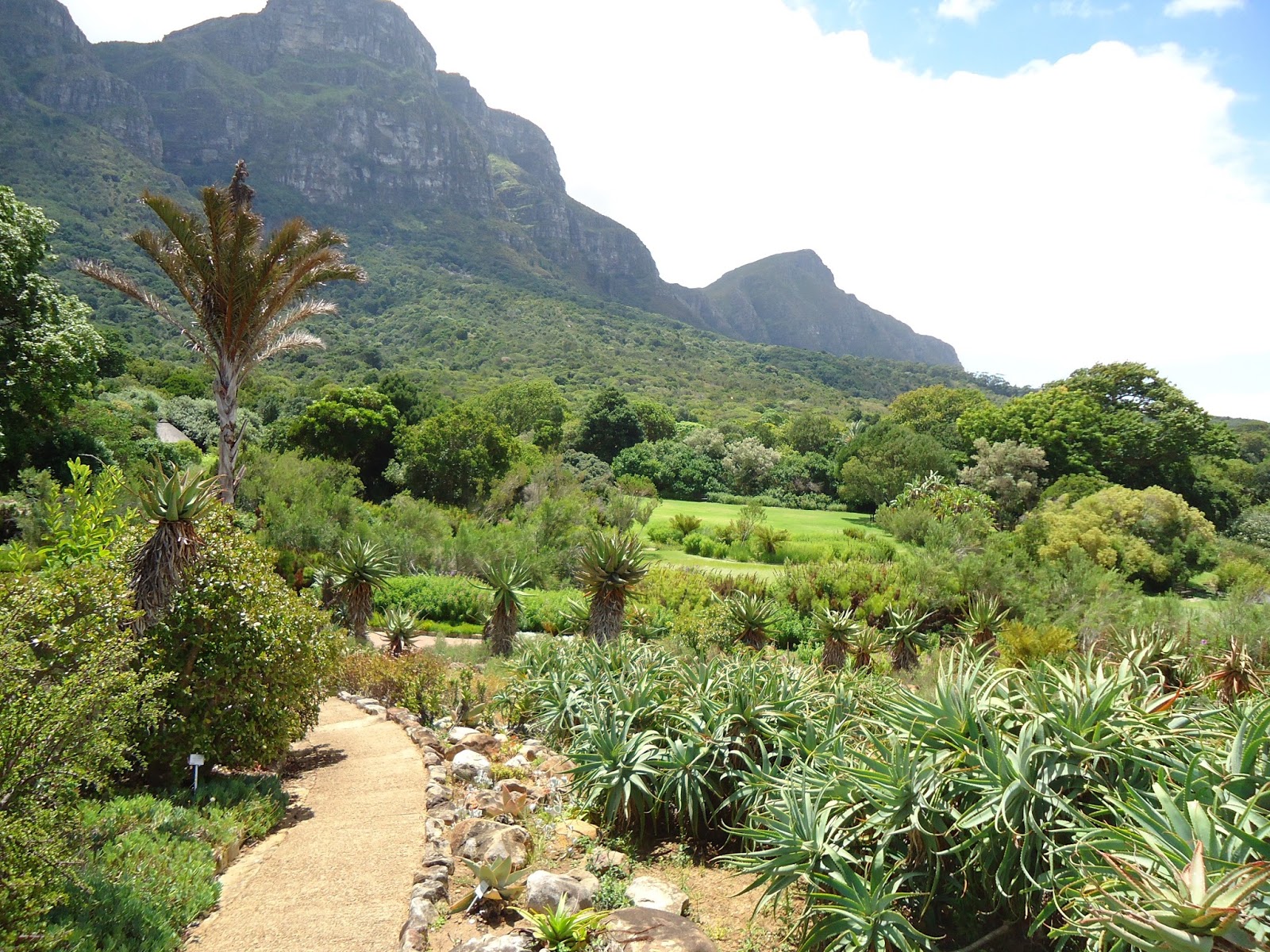
The Kirstenbosch covers 528 hectares (?) and includes a number of theme gardens, including Forest Braille Trail, Fragrance Garden, and a desert house that displays succulents of southern Africa. It is said to be one of the finest botanical gardens in the world. It certainly was impressive. The gardens are also said to have one of the oldest variety of trees—one that may have existed during the dinosaur age. After that long existence, it is close to extinction because of collectors.

The paths through the gardens, which are on the slopes of Table Mountain, are a combination of wide avenues lined with paving stones, smaller trails covered with shiny cobblestones, and narrow paths covered in mulch. A sign warning about snakes, including cobras, was enough to keep us mostly to the main paths.

Botanical Gardens


We started with the path that was all uphill, but we wanted to go to the Tree Canopy Walkway, which was a raised walkway through and over the trees of the arboretum. Because of strong winds, the walkway swayed a bit but provided some spectaculars views.

Tree Canopy Walkway


Most of the plants were unusual to us but especially the Curious Cone, which bares both cones and flowers (they usually only bare cones). The other one was an Aloe Tree, which was an aloe plant with a long tree trunk like a palm tree. A long avenue filled with the remains of Bird of Paradise plants must have been spectacular when the flowers were in bloom.

One of our favorite sections of the gardens had large metal dinosaur models. With Table Mountain looming over us, and being surrounded by trees, we felt as though we were in Jurassic Park.

Dinosaur Park


The bus ride back took us past sandy beaches and beaches covered with large granite boulders. To the right, we could see the other side of Table Mountain and its Twelve Apostles, parts of the mountainside divided by long vertical fissures.

As we got closer to town, we passed large houses that were built right into the cliffs and high up into the hills along the coast. The tour commentator said that the area attracted famous people, including South Africa’s Charlize Theron. The route was so densely developed that many of the houses had multiple parking places on their rooftops—a single parking place costing as much as a home elsewhere in the city. Renting several of them out could cover the cost of your beach house.

The Riviera of South Africa


We also passed a beach that the commentator identified as a nudist beach. The bus went by so quickly, we didn’t see a single nudist—not that we were looking.

Tomorrow, Port Elizabeth, South Africa.